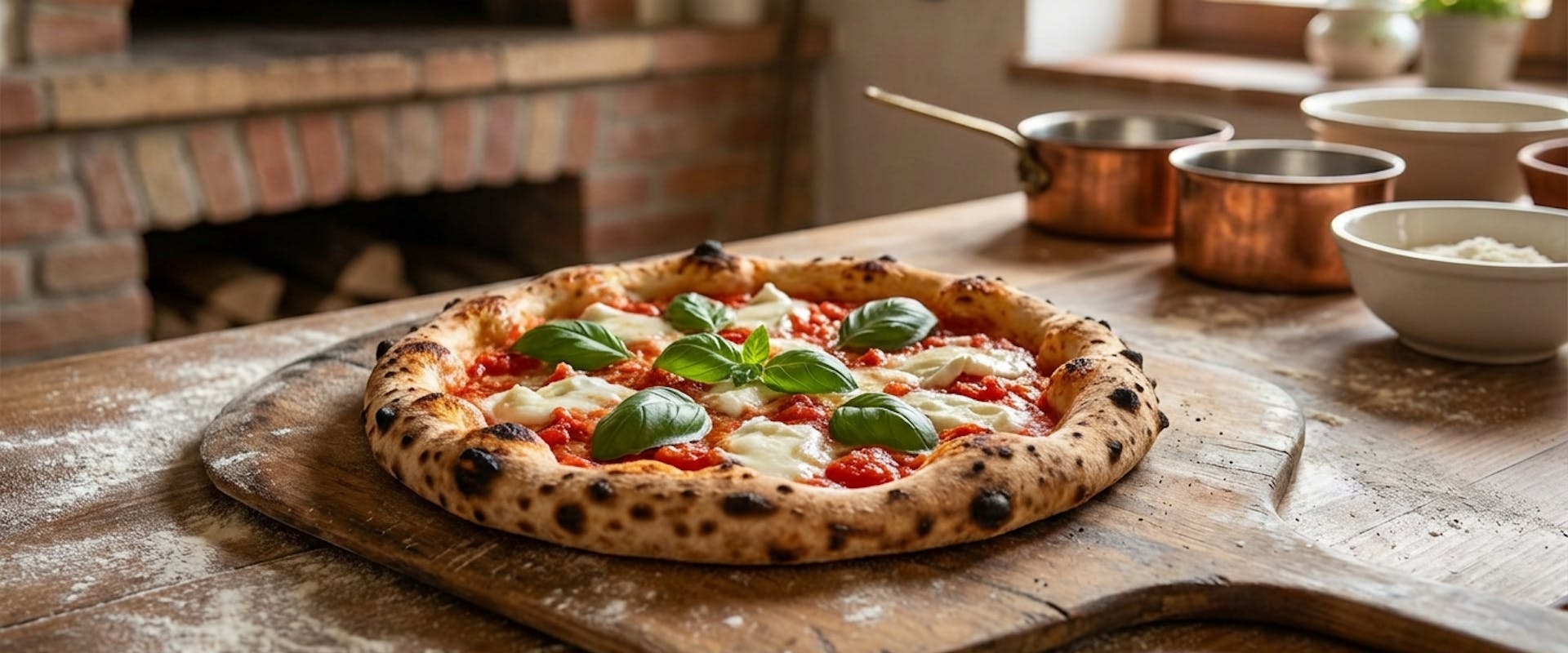

Neapolitan Pizza at Home: Mastering the 48-Hour Dough and Wood-Fired Technique
The dough ball sits on the wooden board, soft and pillowy after 48 hours of slow fermentation. I press my fingertips into the edge, watching the rim inflate while the center stays paper-thin. This is the moment every home pizza maker dreams of—when simple flour and water transform into something that rivals the pizzerias of Naples.
The Philosophy of Neapolitan Pizza
Authentic Neapolitan pizza isn't just food—it's a protected cultural heritage with strict rules. The Associazione Verace Pizza Napoletana (True Neapolitan Pizza Association) defines every detail: the flour type, the tomatoes, even the specific varieties of basil allowed.
But beyond the rules lies a deeper truth: great pizza is about restraint. The dough should taste of wheat, slightly sweet from long fermentation. The sauce should be nothing but crushed San Marzano tomatoes and salt. The cheese should melt into creamy pools, not a thick blanket.
"Less is more," said Enzo Coccia, master pizzaiolo at La Notizia in Naples, when I visited his kitchen. "If you need ten toppings, your dough is not good enough."
The 48-Hour Dough: Why Time Matters
Most home recipes call for same-day dough. This works, but it misses the magic of extended fermentation. Over 48 hours in the refrigerator, enzymes break down complex starches into simple sugars. The dough becomes easier to digest, more flavorful, and develops that characteristic Neapolitan texture—soft and extensible, yet strong enough to support a wet sauce.
The Master Dough Recipe
Ingredients for 4 pizzas:
- 500g tipo 00 flour (Caputo Pizzeria or similar)
- 325ml water (65% hydration)
- 15g fine sea salt
- 1g fresh yeast (yes, just 1 gram)
- 5ml extra virgin olive oil
Day 1 (Evening):
Dissolve the yeast in lukewarm water and let it sit for 5 minutes. In a large bowl, combine flour and salt. Create a well in the center and pour in the yeast water plus olive oil.
Mix with your hands until shaggy, then turn out onto a clean counter. Knead for 10-12 minutes. The dough should be slightly sticky but pull away from your hands cleanly. This is high-hydration dough—it will feel wetter than bread dough.
Place in an oiled container, cover tightly, and refrigerate for 24 hours.
Day 2 (Evening):
Remove dough from the fridge and let it come to room temperature for 1 hour. Divide into 4 equal portions (about 210g each) and shape into tight balls using the pinch-and-tuck method.
Place balls in a lightly oiled container with space between them. Cover and refrigerate for another 24 hours.
Day 3 (Pizza Day):
Remove dough balls from the refrigerator 2-3 hours before baking. They should double in size and feel light and airy.
The Stretch: Hand Technique Over Rolling Pins
Never, ever use a rolling pin on pizza dough. This destroys the air bubbles that create the signature leopard-spotted crust.
The proper stretching technique:
- Flour your work surface generously. Place one dough ball in the center.
- Press down with your fingertips, starting from the center and working outward, leaving a 1-inch border for the crust.
- Pick up the dough and let gravity stretch it. Rotate it between your hands, always holding the edge, never the center.
- When it's 10-11 inches across, lay it on a floured pizza peel.
The center should be thin enough to see light through it. The crust should be puffy and untouched.
The Sauce: Simplicity as Perfection
Authentic Neapolitan pizza uses uncooked sauce. The heat of the oven cooks it perfectly in 90 seconds.
Classic Pizza Sauce Recipe:
- 1 can (400g) San Marzano DOP tomatoes
- Pinch of fine sea salt
- 2-3 fresh basil leaves (torn)
- Optional: tiny pinch of sugar if tomatoes are acidic
Crush the tomatoes by hand directly in the can. Don't blend—you want texture. Season with salt. That's it.
Spread 3-4 tablespoons in the center of your stretched dough, using the back of a spoon in a spiral motion. Leave the outer inch bare for the crust.
The Cheese: Fresh Mozzarella, Properly Drained
Buffalo mozzarella (mozzarella di bufala) is traditional, but high-quality cow's milk fior di latte works beautifully and is easier to find.
The critical step: drain it. Fresh mozzarella holds enormous amounts of water. If you use it straight from the container, your pizza will be soggy.
Slice or tear the mozzarella, then place pieces on paper towels for 15-20 minutes before using. Pat dry.
Use about 80-100g per pizza, distributed in small pieces. Don't cover every inch—you should see sauce between the cheese.
Baking: Replicating the Wood-Fired Oven
Traditional Neapolitan pizza bakes at 485°C (905°F) for 60-90 seconds in a wood-fired oven. Your home oven maxes out around 260°C (500°F), so we must compensate.
The home oven method:
- Place a pizza stone or steel on the highest oven rack, as close to the broiler as possible.
- Preheat for at least 1 hour at maximum temperature.
- Turn on the broiler for the last 5 minutes before baking.
- Slide the pizza onto the hot stone/steel.
- Bake for 6-8 minutes, watching closely.
- For the last 1-2 minutes, switch to broiler to char the top.
The result won't be identical to a wood oven, but it will be excellent—crispy bottom, charred spots on the crust, bubbly cheese.
The Classic Variations
Pizza Margherita
Tomato sauce, mozzarella, fresh basil leaves (added after baking), extra virgin olive oil drizzle.
Pizza Marinara
Tomato sauce, garlic (thinly sliced), oregano, extra virgin olive oil. No cheese—the original poor man's pizza, and absolutely delicious.
Pizza Diavola
Tomato sauce, mozzarella, spicy salami (soppressata piccante). The heat plays beautifully against the sweet tomatoes.
Love Italian cuisine? Discover another Roman classic in our guide to Homemade Pasta in Rome.
Common Mistakes and How to Avoid Them
❌ Using bread flour - It's too strong; the dough won't stretch properly. Tipo 00 is essential.
❌ Too much yeast - More yeast doesn't mean better rise. It means less flavor and a dense, bready texture.
❌ Skipping the cold fermentation - Room temperature dough can't develop the complex flavors.
❌ Overloading toppings - Each additional ingredient adds moisture and weight. Keep it simple.
❌ Insufficient preheating - Your oven must be screaming hot. An hour minimum.
The Outdoor Pizza Oven Option
If you're serious about pizza, consider a portable outdoor oven like an Ooni or Roccbox. These reach authentic temperatures and can bake a pizza in 90 seconds.
I bought an Ooni Koda 16 last year, and it transformed my pizza game. The learning curve is steep—you can burn a pizza in seconds—but the results are restaurant quality.
Flour Matters More Than You Think
Caputo Pizzeria (the blue bag) is the gold standard for Neapolitan pizza. It's milled specifically for long fermentation and high-temperature baking. The protein content (12.5%) creates the perfect texture—strong enough to stretch thin, soft enough to stay tender.
If you can't find Caputo, look for any tipo 00 flour with 11-13% protein. Regular all-purpose flour will work in a pinch but produces a less authentic texture.
Market shopping tips? Learn how to source quality ingredients at Barcelona's La Boqueria Market.
The Cultural Weight of Pizza in Naples
In Naples, pizza isn't casual food—it's an identity. Pizzerias have been family-run for generations, with recipes passed down like heirlooms. The pizza makers (pizzaioli) are artisans, their skills honed over decades.
During my week in Naples, I visited L'Antica Pizzeria da Michele, founded in 1870. They serve only two pizzas: Margherita and Marinara. The line snakes down the street. Inside, pizzaioli work with choreographed precision, stretching, saucing, and baking dozens of pizzas simultaneously.
The crust had that characteristic Neapolitan texture—soft and foldable yet crispy on the bottom, with charred bubbles on the rim. The center was slightly wet, as it should be. This is pizza that must be eaten immediately, with a knife and fork, while it's still too hot to handle.
That's what we're trying to replicate at home—not just the taste, but the philosophy. The respect for simple ingredients. The patience of slow fermentation. The understanding that less, done perfectly, is more.
Making It Your Ritual
The first pizza I made from this recipe was mediocre. The dough stuck to the peel. The sauce was too thick. I burned the crust.
By the tenth attempt, I could stretch the dough with confidence. I understood how the oven behaved. I knew exactly how much flour the peel needed.
By the thirtieth pizza, I stopped following the recipe. My hands knew the dough's texture. I could tell by feel when it had fermented enough. I understood the relationship between heat, time, and perfection.
That's what this recipe offers: not just a meal, but a practice. A way to understand ingredients through repetition. The satisfaction of creating something authentic with your own hands.
Start the dough on Friday evening. Let it rest while you go about your weekend. Sunday evening, invite friends over. Make four pizzas, one after another, each one slightly better than the last.
Watch your guests' faces when they taste it—the surprise that something this good came from your home oven. The questions about your secret. The requests for the recipe.
But you'll know the truth: there is no secret. Just time, temperature, and the willingness to practice until simple ingredients become extraordinary.
That's the lesson Naples teaches. That's what authentic Neapolitan pizza at home really means.